Module 2: OOPs
-
Encapsulation is a process of wrapping up of data under a single unit. It is the mechanism that binds together code and the data its operators.
-
In encapsulation, the data is hidden from the user and can be accessed only through the methods of their current class.
-
In Java, Java Beans is the best example of encapsulation.
  class Student {
  int studentId;
  String studentName;
  Student(int id, String name) { // parameterized constructor
    studentId = id;
    studentName = name;
  }

//  getters and setters
  String getName(){ // getter for studentName
    return studentName;
  }
  int getId(){ // getter for studentId
      return studentId;
  }
  void setName(String name){ // setter for studentName
        studentName = name;
  }
  void setId(int id){ // setter for studentId
        studentId = id;
    }
}- Inheritance is the process of borrowing the properties of one class to another class
- Inheritance is the best way to achieve code reusability.
- In Java, inheritance is achieved by using the
extendskeyword. - The class that inherits the properties of another class is called subclass or child class.
// parent class
class Science {
    // method to know the course
    void knowMyCourse(){
        system.out.println("I am a Science Student");
    }

}
// child class
class Student extends Science{
    int studentId;
    String studentName;
    String  studentCourse;
    // constructor
    Student(int id, String name){
        studentId = id;
        studentName = name;
    }
}
class TestStudent{
    public static void main(String[] args){
        // creating object of child class
        Student s1 = new Student(1, "John");
        // calling method of parent class
        s1.knowMyCourse();
    }
}
There are four types of inheritance in Java:
-
Single Inheritance
- In single inheritance, a class can inherit the properties of only one class.
- In Java, single inheritance is achieved by extending a class. This is the simplest form of inheritance.
-
Multilevel Inheritance
- In multilevel inheritance, a class can inherit the properties of another class and that class can also inherit the properties of another class.
- In Java, multilevel inheritance is achieved by extending a class which is already extended by another class.
-
Hierarchical Inheritance
- In hierarchical inheritance, a class can inherit the properties of more than one class.
- In Java, hierarchical inheritance is achieved by extending more than one class.
-
Hybrid Inheritance
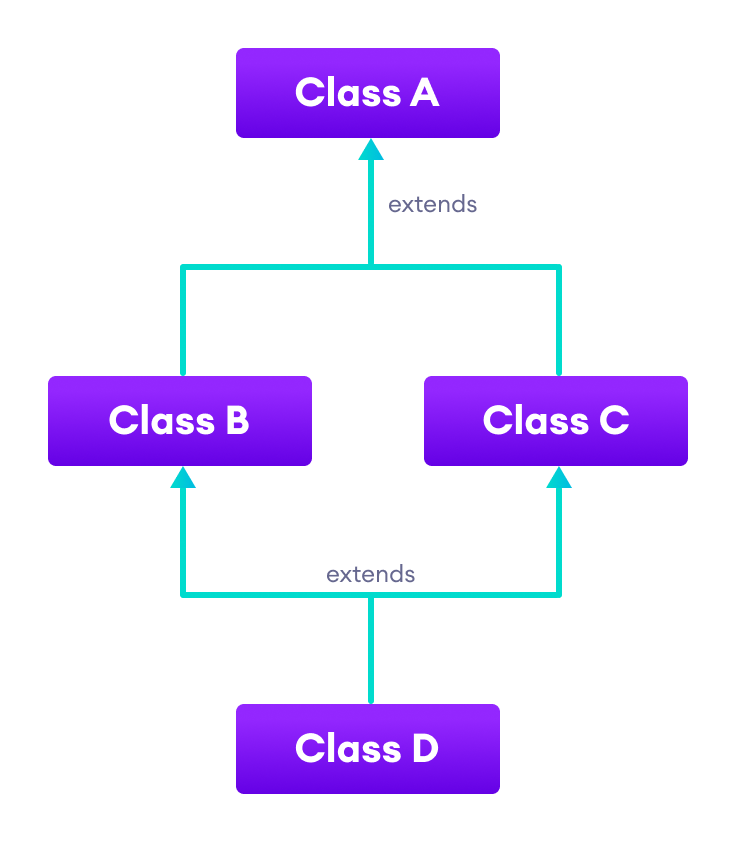
- Hybrid combination is combination of more than one type of inheritance.
- In Java, we can combine two inheritance types to achieve hybrid inheritance.
Note: In Java, multiple inheritance is not supported.


- The word polymorphism means having many forms.
- Polymorphism is the ability of an object to take on many forms and perform single action in different ways.
- In Java, polymorphism is mainly divided into two types:
-
Compile-time Polymorphism
- This type of polymorphism is achieved by method overloading.
-
Runtime Polymorphism
- This type of polymorphism is achieved by method overriding.
-
Compile-time Polymorphism
class Student{
    int studentId;
    int subjectName;
    void display(){
      System.out.println("I am a student");
    }
}
class Person extends Student{
    String name;
    void display(){
      System.out.println("I am a student and Intern at HotWax Systems");
    }
}- In Java, Polymorphism is mainly divided into two types:
-
Compile-time Polymorphism
- This type of polymorphism is achieved by method overloading.
- Method overloading is a feature that allows a class to have more than one method having the same name, if their argument lists are different.
- These methods are said to be overloaded and differentiated by the compiler by the number of parameters in the list and their types.
class Addition{
  void add(int a, int b){
    System.out.println(a+b);
  }
  void add(int a, int b, int c){
    System.out.println(a+b+c);
  }
-
Runtime Polymorphism
- This type of polymorphism is achieved by method overriding.
- Method overriding is a feature that allows a subclass or child class to provide a specific implementation of a method that is already provided by one of its super-classes or parent classes.
class Student{
  void display(){
    System.out.println("I am a student");
  }
}
class Person extends Student{
  void display(){
    System.out.println("I am a student and Intern at HotWax Systems");
  }
}
-
Compile-time Polymorphism