Skip to content

Conversation

@jaganath10486
Copy link

No description provided.

@netlify
Copy link

netlify bot commented Jun 19, 2023

Deploy Preview for zero-trust-network-access ready!

Name Link
🔨 Latest commit 11b26dc
🔍 Latest deploy log https://app.netlify.com/sites/zero-trust-network-access/deploys/64ba368af3512f0008926497
😎 Deploy Preview https://deploy-preview-69--zero-trust-network-access.netlify.app/
📱 Preview on mobile
Toggle QR Code...

QR Code

Use your smartphone camera to open QR code link.

To edit notification comments on pull requests, go to your Netlify site configuration.

@enclave-marc-barry
Copy link
Contributor

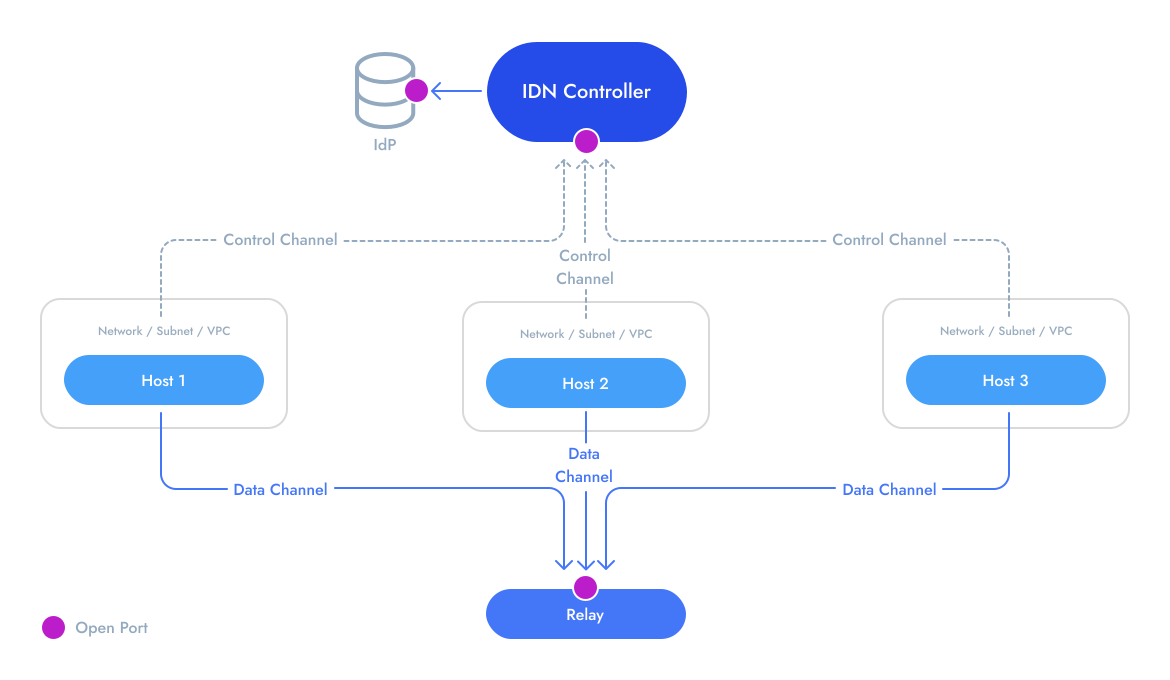
Thanks for the PR @jaganath10486. Could you share an architecture diagram with us so we can sense check you're placed in the correct list

@jaganath10486
Copy link
Author

@enclave-marc-barry Thanks for the response, I forwarded your request to our documentation team. I will get back to you with in next 24 hrs, Thanks you :)

@jaganath10486
Copy link
Author

Hiii @enclave-marc-barry
Please Find the attached Architecture diagram

architecture

@jaganath10486
Copy link
Author

@enclave-marc-barry is there any update from your side?

@jaganath10486
Copy link
Author

Hii @enclave-marc-barry
May I know the reason why still the COSGrid is not added to the list? Is there any thing you needed from our side apart from Architecture diagram?

@enclave-marc-barry
Copy link
Contributor

Hi @jaganath10486, sorry for the delay in getting back to you. Just want to double check you're in the right architecture group.

Thanks for sharing that architecture diagram. If I understood it correctly, it looks like there are four major components of the Cosgrid solution:

  1. MicroZAccess App (for Windows and MacOS)
  2. MicroZAccess App Network Gateway (for IaaS resources)
  3. MicroZAccess App SD-WAN Gateway (for Linux?)
  4. MicroZAccess App Network Gateway (for containers)

In your solution, do the endpoint devices 1 (i.e. Windows and MacOS) have a virtual network interface added by your product to the OS, which then creates direct peer-to-peer tunnels with other endpoint devices, or are tunnels created by and between middle boxes without extending all the way to the endpoint as appears to be the case in 2, 3 and 4?

The architecture looks like a bit of a mix of SDP and ZTON to me, depending on which platform it's deployed to. Unless I'm missing something, from the architecture diagram it appears that the Cosgrid solution creates connectivity between devices and workloads in different locations/subnets via connector appliances / or that all traffic flows via the MicroZAccess TURN Mediator, in which case is the architecture not an IDN?

@jaganath10486
Copy link
Author

jaganath10486 commented Sep 21, 2023

Thanks for the reply @enclave-marc-barry.
Yes, @enclave-marc-barry. To summarize the key components of MicroZAccess:

  1. Management Plane: Orchestrator ( Multi-tenant SaaS)
  2. Control Plane: TURN Mediator ( Shared or Customer Dedicated)
  3. Data Plane: App (Components Options below)
    i. Endpoint Agent (Windows / macOS /Linux) - User + Device Authenticated
    ii. Server/ IoT Edge Agent (Windows / Linux) - Device Authenticated
    iii. App Connector Mode (Linux) - Device Authenticated
    iv. SD-WAN Agent - Device Authenticated
    v. Container Side Car - Device Authenticated
    The endpoints (Data plane components listed above) create direct peer-to-peer tunnels with others based on Zero trust tunnels based on Device trust and enhanced identities. No tunnels terminated in the middleboxes.
    As you've rightly indicated, our firm understanding of this architecture is primarily ZTON + SDP. In our architecture, East-West traffic works well and without traffic traversing over MicroZAccess TURN Mediator (Relays). Hence it doesn't belong not IDN.
    Hope our discussion leads to more clarity and better understanding.

@enclave-marc-barry
Copy link
Contributor

enclave-marc-barry commented Jul 11, 2024

Still confused about whether you're placing Cosgrid in the correct category.

The diagram below indicates that you have software running on endpoints (Windows and MacOS) and are also deploying connector appliances in front of IaaS, VMs, Containers, Linux and Windows and other endpoints.

Is this not an architecture in which the clients connect to an edge device (albeit using STUN/TURN)?

The diagram appears to show a conventional SDP architecture -- an "appliance at the edge", as I've highlighted on the diagram below, and not peer-to-peer connectivity between endpoint devices.

I may be miss-understanding, does the Network Connector / App Connect / SD-WAN Gateway run on the endpoint Windows / Linux / MacOS operating systems directly and create a virtual network interface on the device, or is it deployed separately in front of the target endpoint?

e.g. 100 Windows + Linux VMs == 1 network connector, or 100 network connectors?

Please feel free to add further clarification, or update the PR to place the listing into the SDP category.

image

Sign up for free to join this conversation on GitHub. Already have an account? Sign in to comment

Labels

None yet

Projects

None yet

Development

Successfully merging this pull request may close these issues.

2 participants