In this assignment, you will be given the task to implement methods, in a test driven manner, based on object comparison. You will be dealing with filtering objects and the use of typical search/sorting algorithms. This will be put into practice by using arrays in Java.
- You should use the same method names as specified below.
- Methods should be appropriately documented and tested (see the testing section)
- You should strive to implement the tests first before you implement the code for the methods. Of course
this will usually mean that the code will not compile unless you have created the method. A workaround for
this is to simply create the method and just leave it empty (alternatively return a dummy value if it requires
a return). See the method
removeRectanglesLargerThaninsrc/RectangleArrayProcessor.java.
Important: have a look at the Testing section before you start coding!
A Rectangle class has been provided for you in src/Rectangle.java. Make
yourself familiar with the source code and note that the compareTo method has been overriden so that instances of
Rectangle can be compared by their area. Information on Object Ordering and
Comparable can be found
here.
It's also important to note that we've overridden the equals method. According to the method, do we consider
a Rectangle to be the same as another one based on object identity or field values? Hopefully, it
shouldn't be hard to guess.
We of course need a way to process Rectangles so therefore you've been given a Java class
src/RectangleArrayProcessor.java.
This class will contain your methods.
More specifically, your task is to implement the following methods:
- A method
removeRectanglesLargerThanthat takes aRectanglearray and anintn and returns an array containing only the rectangles with a smaller area than n. - Another method
removeRectanglesLargerThan(yes, now we're overloading :) ) that takes aRectanglearray and aRectangler and returns an array containing only the rectangles with a smaller area than r's area. - A method
containsSquarethat takes aRectanglearray and returnstrueif the array contains a square or false otherwise. - Another method
filterRectanglesWithEqualAreathat takes aRectanglearray and aRectangler and returns an array containing only the rectangles with an area equal to r's area.
You have been provided with a test class for Rectangle at
test/RectangleTest.java which should pass. The test class
you will be working on is
test/RectangleArrayProcessorTest.java.
The given tests will not compile unless you have added
the Junit5 library and the
Hamcrest library so make sure you get them either
directly via IntelliJ or by manually downloading the jar files and linking them to
the project.
Note: the following parts deal with algorithms which is actually part of next week's module. While they're not obligatory, it would probably not be a bad idea to start getting acquainted with the material beforehand.
- Algoritmer(SWEDISH)
- What is an algorithm?
- Hur snabb är datorn?(SWEDISH)
- Complexity and Big-O Notation
- Choose either the Selection sort or Insertion sort algorithm, as shown below
- In
RectangleArrayProcessorclass, the header for the sorting method should be the following:public void sort(Rectangle[] array)
- Expected behaviour: list of Rectangle objects will be sorted by increasing area
- You must use
Rectangle.compareTo(Rectangle)for all comparison operations. - You should make tests for the functionality before you implement the method.
Assistant's note: Notice how the return type is
void? This gives away the fact that these methods sort in place. That is to say, they are supposed to mutate the argument array/list, instead of returning a copy.
Assistant's 2nd note: The motivation for using
Comparable<Rectangle>interface earlier in rectangle is simple but perhaps not obvious. The benefit of using it is that we can implement generic comparison based algorithms (such as search and sort) that don't actually know what they are comparing by. For the sake of keeping complexity down, you will only be implementing algorithms specifically for theRectangleclass here, but with a small change to the method signatures, one could make the algorithms work for any classTthat implementsComparable<T>(ask your assistant if you are curious). An implication, and huge benefit, of the search/sort not having anything to do with the comparison is that if we decide that we want to compare by for example height alone, we only need to changecompareTo!
Insertion Sort (A)
------------------
1   for i = 1 to A.length - 1
2       j = i
3       while j > 0 and A[j-1] > A[j]
4           temp = A[j]
5           A[j] = A[j-1]
6           A[j-1] = temp
7           j = j - 1
To help you understand how it works, here is a (horribly slow, blame Wikipedia) visualization of insertion sort:
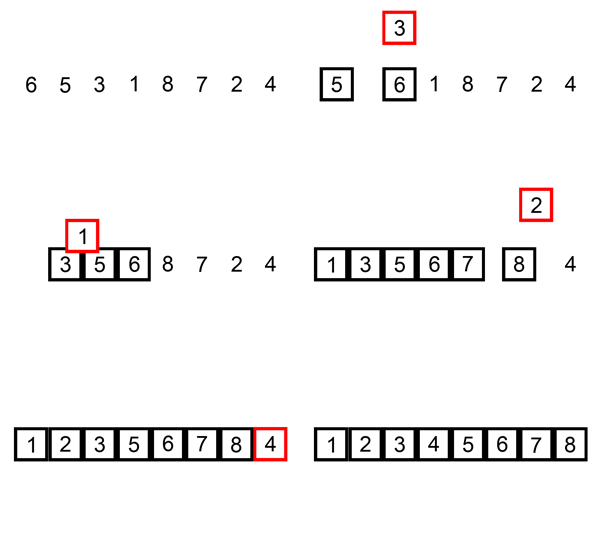
Selection Sort (A)
------------------
1   for i = 0 to A.length - 1
2       min = i
3       for j = i + 1 to A.length - 1
4           if A[j] < A[min]
5               # minimum element found
6               min = j
7       temp = A[i]
8       A[i] = A[min]
9       A[min] = temp
To help you understand how it works, here is a (pretty neat, thank Wikipedia) visualization of selection sort:
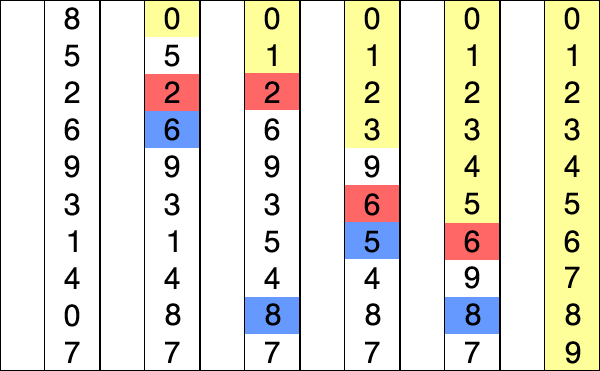
Now you will create an iterative sequential search algorithm that searches for a Rectangle that is comparably equal to a specified Rectangle. This will be a 'brute force' approach that simply iterates through all elements.
- In
RectangleProcessorclass, implement the search method with the following header:public int sequentialSearch(Rectangle[] array, Rectangle rectangle)
- Expected behaviour: return index of the first
Rectanglethat has the same area asrectangle, or -1 if no suchRectangleis present. - You must use
Rectangle.compareTo(Rectangle)for all comparison operations. - You should make tests for the functionality before you implement the method.
If you assume that the input array/list is sorted, you can use the binary search algorithm to improve search performance. Create a recursive (or iterative) version of the binary search algorithm that searches for a Rectangle that is comparably equal to a specified Rectangle.
- In your
RectangleProcessorclass, implement the method with the following header:public int binarySearch(Rectangle[] array, Rectangle rectangle)
- You should make tests for the functionality before you implement the method.
- When testing, be sure to always use sorted lists/arrays as input.
- Expected behaviour: return index of any
Rectanglethat has the same area asrectangle, or -1 if no suchRectangleis present. - You must use
Rectangle.compareTo(Rectangle)for all comparison operations.
For this week's testing, you've been provided with two test classes.
test/RectangleTest.java, which you do not have to do any more work on,
is just there to make sure that Comparable<Rectangle> is correctly implemented.
Make sure to run it before you make your final push. Comparable is the interface which allows
the user to define how an Object should be compared to another Object of the same type.
The second test class, and the one you should work on, is
test/RectangleArrayProcessorTest.java. You have been given one
test implementation as an example. You should implement tests for all methods.
There should be at least one negative and one positive test where applicable.
Questions that you should reflect and discuss with other students:
- How many tests are enough?
- What might be important to test?
Assistant's note: It is in your own best interests to take the testing seriously, as if you properly implement the test class and then pass all of the tests, you can be confident that your code will work as expected.
There are of course more sorting algorithms and if you have time over, go ahead and implement another one of your choice (for example mergesort or quicksort)!