As a user, I can see my keyword raw result #8
Conversation


 rosle
force-pushed
the
feature/scrap-google-result
branch
from
rosle
force-pushed
the
feature/scrap-google-result
branch
from
2218905 to
4f85743
Compare
rosle
force-pushed
the
feature/scrap-google-result
branch
from
6f8f71b to
e3ebe3c
Compare

| {:reply, :ok, new_state} | ||
| end | ||
|
|
||
| def handle_info({ref, result}, state) do |

There was a problem hiding this comment.
How/when does handle_info gets called? 🤔 start_task is started without any links so how?
There was a problem hiding this comment.
For this one,
it happens when we start the task with Task.Supervisor.async_nolink below. it will send the message with task reference and the result back here.
But if the task is failed, it will trigger the handle_info({:DOWN, ref, :process, _pid, _reason}, state) below.
More info:
https://hexdocs.pm/elixir/Task.Supervisor.html#async_nolink/3
There was a problem hiding this comment.
I understood more by seeing the actual code example.
At first, I was confused as I thought that the supervisor would be notified, not the Genserver. For the supervisor to be notified, then it requires to use start_child.
| @@ -0,0 +1,84 @@ | |||
| defmodule GoogleCrawler.SearchKeywordWorker do | |||
There was a problem hiding this comment.
But if this process dies then all state would be gone, right?
When restarting should it then reads from the database to pick up all keyword remaining to be scraped? 🤔
There was a problem hiding this comment.
Yep true. I haven't think about this case 😂
rosle
force-pushed
the
feature/scrap-google-result
branch
2 times, most recently
from
bbcff27 to
2d1ea89
Compare
rosle
force-pushed
the
feature/scrap-google-result
branch
2 times, most recently
from
2f6e4fc to
0648d54
Compare
rosle
force-pushed
the
feature/scrap-google-result
branch
from
0648d54 to
9b3fd44
Compare
| end | ||
|
|
||
| defp google_api_client do | ||
| Application.get_env(:google_crawler, :google_api_client) |
There was a problem hiding this comment.
I noticed that you used the same technic to inject the right module based on the environment (as per this blog post I shared). I even feel that this is something we could bring to Ruby projects
There was a problem hiding this comment.
Another interesting ideas -> https://medium.com/flatiron-labs/rolling-your-own-mock-server-for-testing-in-elixir-2cdb5ccdd1a0 🤔 This one is to running a server in the test env.
| assert %{^task_ref => {keyword, 0}} = SearchKeywordWorker.get_state() | ||
| assert Search.get_keyword(keyword.id).status == :in_progress | ||
|
|
||
| :timer.sleep(1000) |
There was a problem hiding this comment.
How about adding the sleep in the Google API Client Mock to simulate delays?
There was a problem hiding this comment.
I think adding the delay to the client, we will need to put here also because we need to wait for the task to complete. (api is called in the task)
I found there is another way that we can monitor if the task is actually finish -> https://stackoverflow.com/questions/28745193/testing-asynchronous-code-in-elixir/28746505#28746505
Which I can do something like
task = SearchKeywordWorker.search(keyword.id)

ref = Process.monitor(task.pid)
assert_receive {:DOWN, ^ref, :process, _, :normal}, 500
But because even if the task is completed, I do some db update in the genserver handle_info and I encounters the error
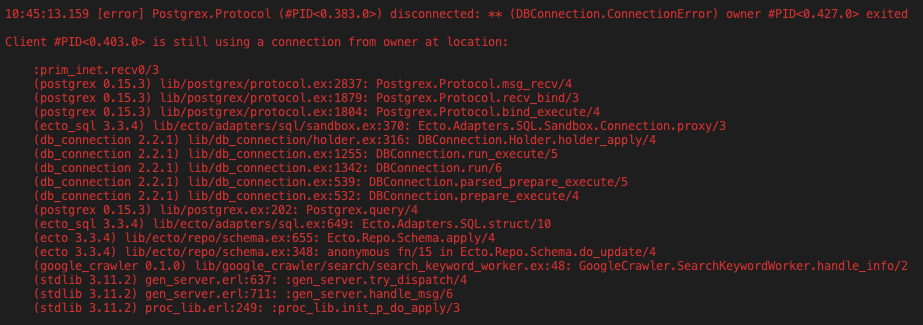
I'm not completely sure what it is but maybe they're trying to update(in the genserver) and get the record(in the assertion). So when I use that, I added that I had to put antoher sleep before the assertion to make it work
ref = Process.monitor(task.pid)
assert_receive {:DOWN, ^ref, :process, _, :normal}, 500
:timer.sleep(100)
🤔 💭
| @@ -0,0 +1,22 @@ | |||
| defmodule GoogleCrawler.Google.ApiClientBehaviour do | |||
| @callback search(keyword :: String.t()) :: {:ok, String.t()} | {:error, String.t()} | |||
| end | |||
There was a problem hiding this comment.
It's actually a good idea to use a behaviour so make sure that both the actual and mock modules have the same implementation.


What happened
✅ Setup sass
✅ Run the background job to get the result from google search - experiment with GenServer
✅ Update the keyword status and result
Insight
For this one, I am trying to setup a background job to search. A GenServer + Task Supervisor is setup to handle that.
There are still some known problems that I need to investigate and fix later. 😓
Proof Of Work
After upload the keyword, it shows the status on the list
The status is updated after the keyword search is done
User can click on the
view_resultto view the search result