This project includes a C implementation of the classic Producer-Consumer problem in Linux using semaphores, shared memory, threads, and two processes. This implementation is desgined to demonstrate how two processes with threads can communicate with each other using a shared memory buffer.
- Linux Operating System (Testing was done on Ubuntu in VirtualBox)
- GCC compiler
- Terminal
- Clone the repository OR download the files by navigating to the folder titled "C"
- Open the folder in your Linux terminal
- Make sure to have GCC up to date (gcc --version)
- Compile using a couple commands:
- gcc producer.c -pthread -lrt -o producer
- gcc consumer.c -pthread -lrt -o consumer
- ./producer & ./consumer &
- Success!
In computer science, a producer-consumer example program is a program that simulates a scenario where there are two types of process, one producing data and the other consuming it. The producer process generates data items and puts them into a shared buffer, while the consumer process reads data from the buffer and processes it.
In this example program, the producer and consumer processes run concurrently, with the producer process generating data items at a certain rate and adding them to a shared buffer. The consumer process continuously reads data from the buffer and processes it, one item at a time. If the buffer is empty, the consumer process will wait until a new item is added by the producer process.
To prevent synchronization issues, the producer and consumer processes need to coordinate their actions. The producer process must ensure that the buffer is not full before adding a new data item to it, while the consumer process must ensure that the buffer is not empty before attempting to read from it. This coordination is achieved in this implementation through the use of a semaphore.
The producer-consumer example program is commonly used to illustrate how to implement process synchronization, potentially illustrate the similarities with multithreaded programming, and demonstrate the importance of using synchronization primitives to prevent race conditions and other synchronization issues.
In this particular implementation, the producer process will create a thread that will create a shared memory buffer and initialize two semaphores. The consumer process will create a thread that will attach to the shared memory buffer created by the producer process. The shared memory buffer contains the two semaphores as well as a table for the two processes/threads to exchange information. The processes/threads will exhibit mutual exclusion while passing arbitrary integers from the producer to the consumer. Once a specified number of iterations are complete, each thread will have finished their goal. The semaphores will be destroyed and the shared memory will be detached.
You can customize the program by changing the following constants defined in BOTH the producer.c and consumer.c files: (You must change the constants in both of the files or the program will not function properly.)
SIZE: Size of the shared memory tableSHM_KEY: Key used for the shared memory bufferITERATIONS: Number of iterations you would like the two processes to attempt the critical section
Note: ITERATIONS is set to 10

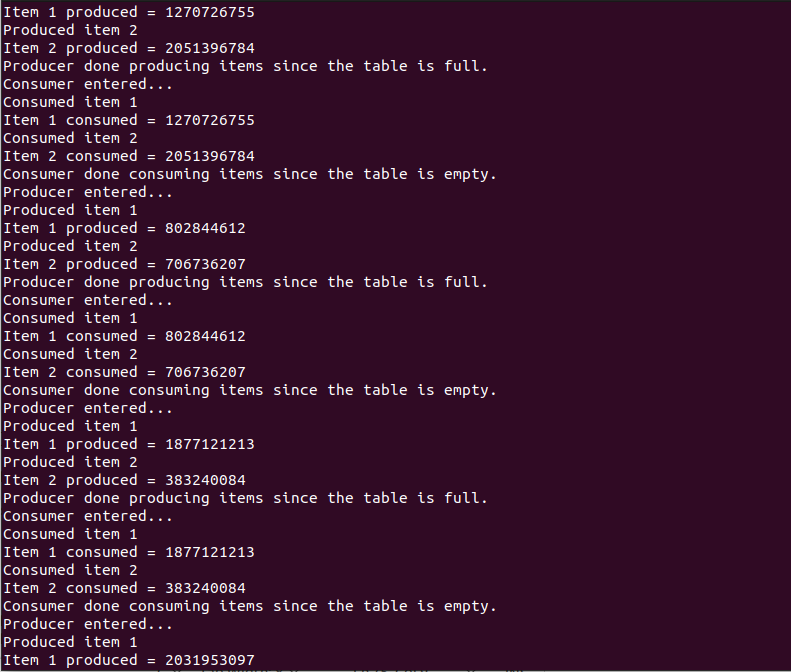
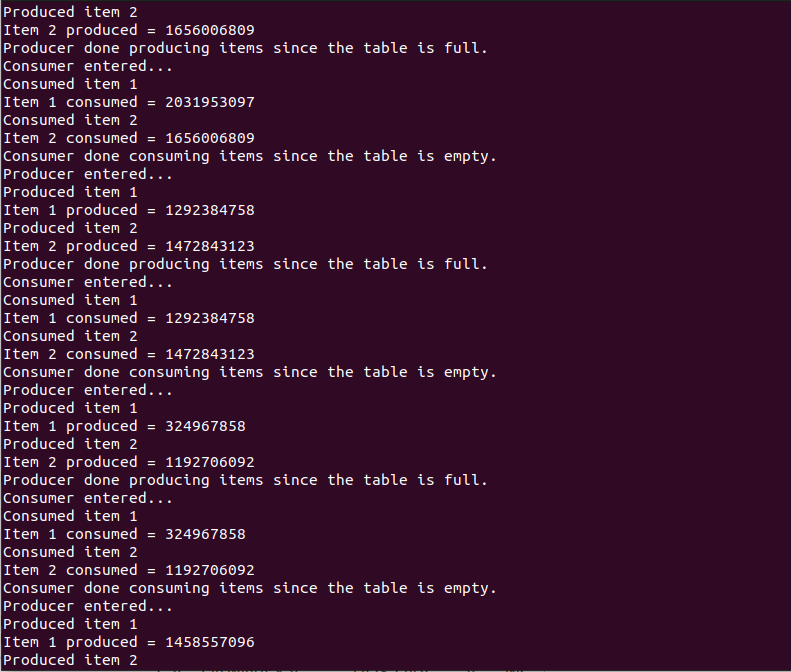

The creation of this producer consumer problem implementation had many twists and turns. Originally, this implementation started its life out as a C++ program. It began as a single file, named "producer_consumer.cpp" that attempted to create two threads instead of two processes. The two threads would then communicate between each other through a shared memory buffer, however this implemenation had many issues and was eventually scrapped due to many errors. The next version of the implemenation contained two processes, "producer.cpp" and "consumer.cpp." This implementation was similar to the current version, but did not contain threads. It was two processes that would share a memory buffer and communicate through that shared buffer, however there was many errors and mistakes. The main problem with this version was that every time the consumer process called "wait" on the "mutex" semaphore, it would cause a segmentation fault. Onto the drawing board again, I received a suggestion to implement the producer consumer problem in C instead of C++. Although I have never written code in C, I took on the challenge. What was created is the current, and most functional version. Through help of Khushi Patel, I learned how to change what I already had created in C++ into C. At that point, I just had two programs that would interact with each other, but it did not use proper semaphores and would infinitely loop. I learned from online documentation how to implement the semaphores and threads properly. I kept adding features that contributed to the project's goal, until it reached the state it is at now. This was an excellent learning process, and I enjoyed challenging myself to adapt to creating with unfamiliar technology. You can view the other older versions through the different branches on this repository.
- nmarhari with a special thank you to Khushi Patel
- This implementation was created by Nassim Marhari. It is based on the classic producer-consumer problem and uses the System V IPC shared memory mechanism in Linux.