This is the codebase for the paper: "Less is More: Recursive Reasoning with Tiny Networks". TRM is a recursive reasoning approach that achieves amazing scores of 45% on ARC-AGI-1 and 8% on ARC-AGI-2 using a tiny 7M parameters neural network.
Tiny Recursion Model (TRM) is a recursive reasoning model that achieves amazing scores of 45% on ARC-AGI-1 and 8% on ARC-AGI-2 with a tiny 7M parameters neural network. The idea that one must rely on massive foundational models trained for millions of dollars by some big corporation in order to achieve success on hard tasks is a trap. Currently, there is too much focus on exploiting LLMs rather than devising and expanding new lines of direction. With recursive reasoning, it turns out that “less is more”: you don’t always need to crank up model size in order for a model to reason and solve hard problems. A tiny model pretrained from scratch, recursing on itself and updating its answers over time, can achieve a lot without breaking the bank.
This work came to be after I learned about the recent innovative Hierarchical Reasoning Model (HRM). I was amazed that an approach using small models could do so well on hard tasks like the ARC-AGI competition (reaching 40% accuracy when normally only Large Language Models could compete). But I kept thinking that it is too complicated, relying too much on biological arguments about the human brain, and that this recursive reasoning process could be greatly simplified and improved. Tiny Recursion Model (TRM) simplifies recursive reasoning to its core essence, which ultimately has nothing to do with the human brain, does not require any mathematical (fixed-point) theorem, nor any hierarchy.
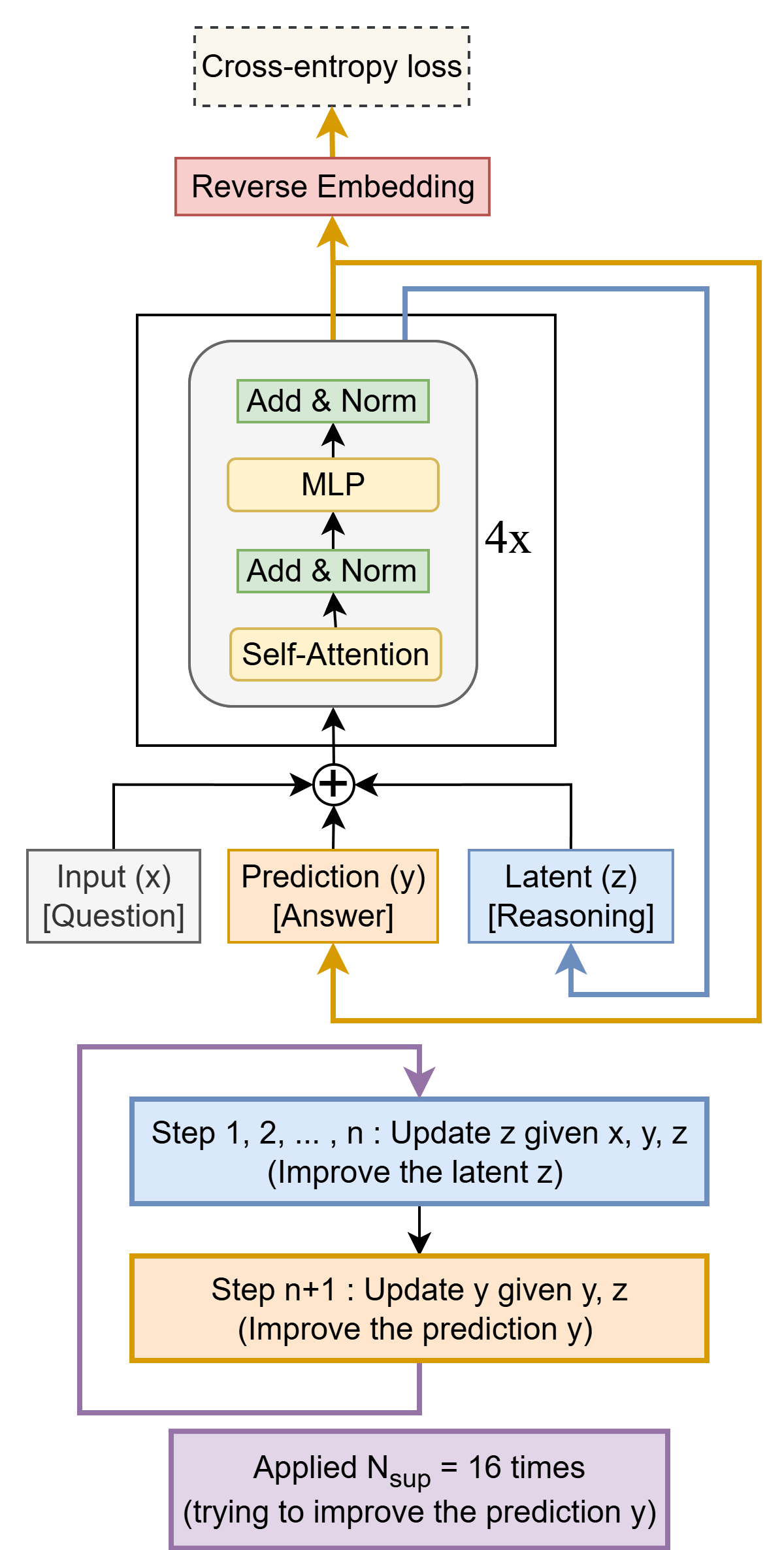
Tiny Recursion Model (TRM) recursively improves its predicted answer y with a tiny network. It starts with the embedded input question x and initial embedded answer y and latent z. For up to K improvements steps, it tries to improve its answer y. It does so by i) recursively updating n times its latent z given the question x, current answer y, and current latent z (recursive reasoning), and then ii) updating its answer y given the current answer y and current latent z. This recursive process allows the model to progressively improve its answer (potentially addressing any errors from its previous answer) in an extremely parameter-efficient manner while minimizing overfitting.
We also include a hybrid model that combines TRM with advanced memory management techniques from Dr. Josef Kurk Edwards' research:
- ERS (Enhanced Reconsideration System): Persistent memory with temporal decay, consensus strengthening, and contradiction detection
- PMLL (Persistent Memory Logic Loops): Multi-pass validation with lattice-based tensor routing
- Topic Integrator: Knowledge graph integration for topic-aware reasoning
This hybrid model maintains the parameter efficiency of TRM while adding stateful memory management for improved long-term consistency and handling of contradictory information. See docs/TRM_ERS_PMLL_HYBRID.md for details.
We provide comprehensive documentation for benchmarking agents on the ARC-AGI-3 platform. The benchmarking harness allows you to:
- Run repeatable agent evaluations across different models
- Generate official scorecards and replays
- Compare model versions and prompt strategies
- Detect regressions after code changes
See docs/BENCHMARKING.md for the complete benchmarking guide.
Installation should take a few minutes. For the smallest experiments on Sudoku-Extreme (pretrain_mlp_t_sudoku), you need 1 GPU with enough memory. With 1 L40S (48Gb Ram), it takes around 18h to finish. In case that you run into issues due to library versions, here is the requirements with the exact versions used: specific_requirements.txt.
- Python 3.10 (or similar)
- Cuda 12.6.0 (or similar)
pip install --upgrade pip wheel setuptools
pip install --pre --upgrade torch torchvision torchaudio --index-url https://download.pytorch.org/whl/nightly/cu126 # install torch based on your cuda version
pip install -r requirements.txt # install requirements
pip install --no-cache-dir --no-build-isolation adam-atan2
wandb login YOUR-LOGIN # login if you want the logger to sync results to your Weights & Biases (https://wandb.ai/)# ARC-AGI-1
python -m dataset.build_arc_dataset \
--input-file-prefix kaggle/combined/arc-agi \
--output-dir data/arc1concept-aug-1000 \
--subsets training evaluation concept \
--test-set-name evaluation
# ARC-AGI-2
python -m dataset.build_arc_dataset \
--input-file-prefix kaggle/combined/arc-agi \
--output-dir data/arc2concept-aug-1000 \
--subsets training2 evaluation2 concept \
--test-set-name evaluation2
## Note: You cannot train on both ARC-AGI-1 and ARC-AGI-2 and evaluate them both because ARC-AGI-2 training data contains some ARC-AGI-1 eval data
# Sudoku-Extreme
python dataset/build_sudoku_dataset.py --output-dir data/sudoku-extreme-1k-aug-1000 --subsample-size 1000 --num-aug 1000 # 1000 examples, 1000 augments
# Maze-Hard
python dataset/build_maze_dataset.py # 1000 examples, 8 augmentsrun_name="pretrain_mlp_t_sudoku"
python pretrain.py \
arch=trm \
data_paths="[data/sudoku-extreme-1k-aug-1000]" \
evaluators="[]" \
epochs=50000 eval_interval=5000 \
lr=1e-4 puzzle_emb_lr=1e-4 weight_decay=1.0 puzzle_emb_weight_decay=1.0 \
arch.mlp_t=True arch.pos_encodings=none \
arch.L_layers=2 \
arch.H_cycles=3 arch.L_cycles=6 \
+run_name=${run_name} ema=True
Expected: Around 87% exact-accuracy (+- 2%)
run_name="pretrain_att_sudoku"
python pretrain.py \
arch=trm \
data_paths="[data/sudoku-extreme-1k-aug-1000]" \
evaluators="[]" \
epochs=50000 eval_interval=5000 \
lr=1e-4 puzzle_emb_lr=1e-4 weight_decay=1.0 puzzle_emb_weight_decay=1.0 \
arch.L_layers=2 \
arch.H_cycles=3 arch.L_cycles=6 \
+run_name=${run_name} ema=TrueExpected: Around 75% exact-accuracy (+- 2%)
Runtime: < 20 hours
run_name="pretrain_att_maze30x30"
torchrun --nproc-per-node 4 --rdzv_backend=c10d --rdzv_endpoint=localhost:0 --nnodes=1 pretrain.py \
arch=trm \
data_paths="[data/maze-30x30-hard-1k]" \
evaluators="[]" \
epochs=50000 eval_interval=5000 \
lr=1e-4 puzzle_emb_lr=1e-4 weight_decay=1.0 puzzle_emb_weight_decay=1.0 \
arch.L_layers=2 \
arch.H_cycles=3 arch.L_cycles=4 \
+run_name=${run_name} ema=True
Runtime: < 24 hours
Actually, you can run Maze-Hard with 1 L40S GPU by reducing the batch-size with no noticable loss in performance:
run_name="pretrain_att_maze30x30_1gpu"
python pretrain.py \
arch=trm \
data_paths="[data/maze-30x30-hard-1k]" \
evaluators="[]" \
epochs=50000 eval_interval=5000 \
lr=1e-4 puzzle_emb_lr=1e-4 weight_decay=1.0 puzzle_emb_weight_decay=1.0 global_batch_size=128 \
arch.L_layers=2 \
arch.H_cycles=3 arch.L_cycles=4 \
+run_name=${run_name} ema=True
Runtime: < 24 hours
run_name="pretrain_att_arc1concept_4"
torchrun --nproc-per-node 4 --rdzv_backend=c10d --rdzv_endpoint=localhost:0 --nnodes=1 pretrain.py \
arch=trm \
data_paths="[data/arc1concept-aug-1000]" \
arch.L_layers=2 \
arch.H_cycles=3 arch.L_cycles=4 \
+run_name=${run_name} ema=True
Runtime: ~3 days
run_name="pretrain_att_arc2concept_4"
torchrun --nproc-per-node 4 --rdzv_backend=c10d --rdzv_endpoint=localhost:0 --nnodes=1 pretrain.py \
arch=trm \
data_paths="[data/arc2concept-aug-1000]" \
arch.L_layers=2 \
arch.H_cycles=3 arch.L_cycles=4 \
+run_name=${run_name} ema=True
Runtime: ~3 days
We now support running TRM as an agent on the ARC-AGI-3 platform! This allows you to use recursive reasoning to play ARC-AGI-3 games.
# Run the TRM agent experiment
python experiments/run_trm_arc_agi_3.py --game=ls20

# Run tests
python tests/test_trm_agent.py

# Run with main.py
python main.py --agent=trmagent --game=ls20For complete integration with the official ARC-AGI-3 API, follow the detailed guide in docs/ARC_AGI_3_INTEGRATION.md.
Key features:
- TRM agent compatible with ARC-AGI-3 framework
- Configurable recursive reasoning cycles
- Support for both local simulation and full API integration
- Comprehensive test suite
See the ARC-AGI-3 Integration Guide for more details.
We now support RNA 3D structure prediction using TRM! This integration leverages the jrc-rna-structure-pipeline to predict 3D coordinates of RNA molecules.
# Clone and setup the RNA structure pipeline
git clone https://github.com/JaneliaSciComp/jrc-rna-structure-pipeline.git

# Prepare RNA dataset
python dataset/build_rna_dataset.py \
  --sequences train_sequences.csv \
  --labels train_labels.csv \
  --output-dir data/rna-structure

# Train TRM for RNA structure prediction
python pretrain_rna.py \
  --data-dir data/rna-structure \
  --epochs 100 \
  --num-structures 5

# Generate predictions (5 structures per sequence)
python predict_rna.py \
  --model-path checkpoints/rna/best_model.pth \
  --sequences test_sequences.json \
--output submission.csvUse the workflow script for end-to-end processing:
bash workflows/rna_structure_prediction.sh \
  --sequences train_sequences.csv \
  --labels train_labels.csv \
--test-sequences test_sequences.csv- Multi-conformation prediction: Generates 5 different valid 3D structures per RNA sequence
- Recursive reasoning: TRM's recursive approach captures complex RNA folding patterns
- Competition-ready: Outputs in Kaggle competition format (Stanford RNA 3D Folding Part 2)
- Scalable: Supports multi-GPU training for large datasets
For the Stanford RNA 3D Folding Part 2 competition:
# Use the Kaggle submission notebook
kaggle_submission_notebook.ipynb

# Or run the submission script
python kaggle_submission.py
See the Kaggle Submission Guide for detailed competition instructions.
- RNA Integration Guide - Full documentation
- Kaggle Submission Guide - Competition submission
- RNA Example - Step-by-step tutorial
- RNA Quick Reference - Quick start guide
If you find our work useful, please consider citing:
@misc{jolicoeurmartineau2025morerecursivereasoningtiny,
      title={Less is More: Recursive Reasoning with Tiny Networks},
      author={Alexia Jolicoeur-Martineau},
      year={2025},
      eprint={2510.04871},
      archivePrefix={arXiv},
      primaryClass={cs.LG},
      url={https://arxiv.org/abs/2510.04871},
}@misc{josef_edwards_alexiajm_2026,
title={Rtmtrm},
url={https://www.kaggle.com/dsv/14685757},
DOI={10.34740/KAGGLE/DSV/14685757},
publisher={Kaggle},
author={Josef Edwards and AlexiaJM},
year={2026}
}and the Hierarchical Reasoning Model (HRM):
@misc{wang2025hierarchicalreasoningmodel,
      title={Hierarchical Reasoning Model},
      author={Guan Wang and Jin Li and Yuhao Sun and Xing Chen and Changling Liu and Yue Wu and Meng Lu and Sen Song and Yasin Abbasi Yadkori},
      year={2025},
      eprint={2506.21734},
      archivePrefix={arXiv},
      primaryClass={cs.AI},
      url={https://arxiv.org/abs/2506.21734},
}
This code is based on the Hierarchical Reasoning Model code and the Hierarchical Reasoning Model Analysis code.