Creature
A Creature is an inhabitant of our virtual world, which evolves, reproduces, interacts with the other creatures and dies.
Every tick (unit of measurement of time), every creature search in the portion of world composed by 7x7 chunks around itself, where it should go (considering the quantity of food in every chunk e its distance from it). When it arrives to the destination, it eats, increasing its energy and decreasing the food present. Every tick the creatures lose a certain quantity of energy, which is proportional to their energy.
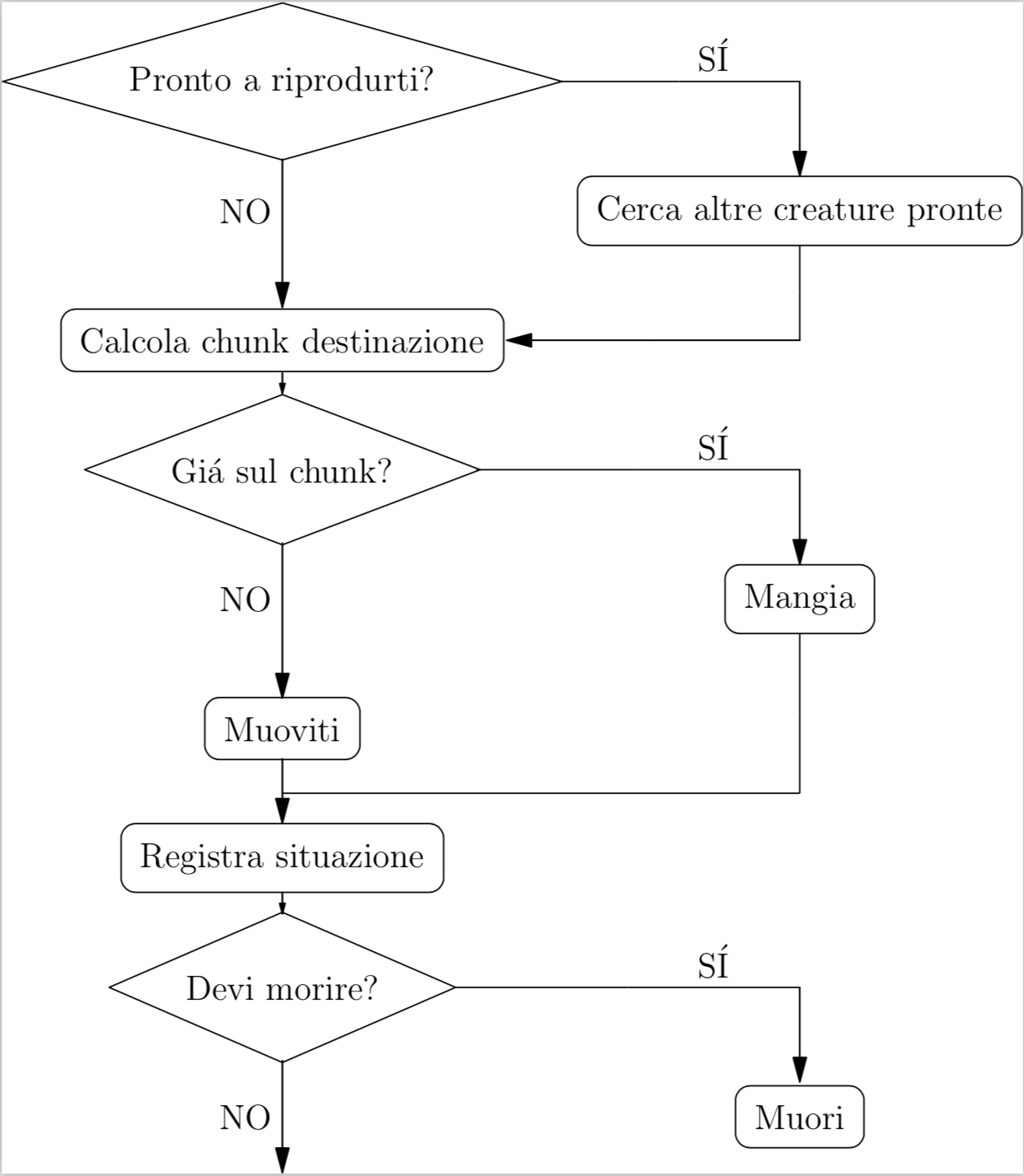
Reproduction is random between two creature who are in a portion of the world of 7x7 chunks. In particular, if two creatures have got enough energy they reproduce, creating a new creature who has got similar characteristics. During the reproduction, parents lose a certain quantity of energy, which they give to they child.
The death of creature can be caused by three factors:
- Old age: the maximum age is calculated at birth according to a random number with Gaussian trend with mean equal to 1000 tick and standard deviation of 200 tick.
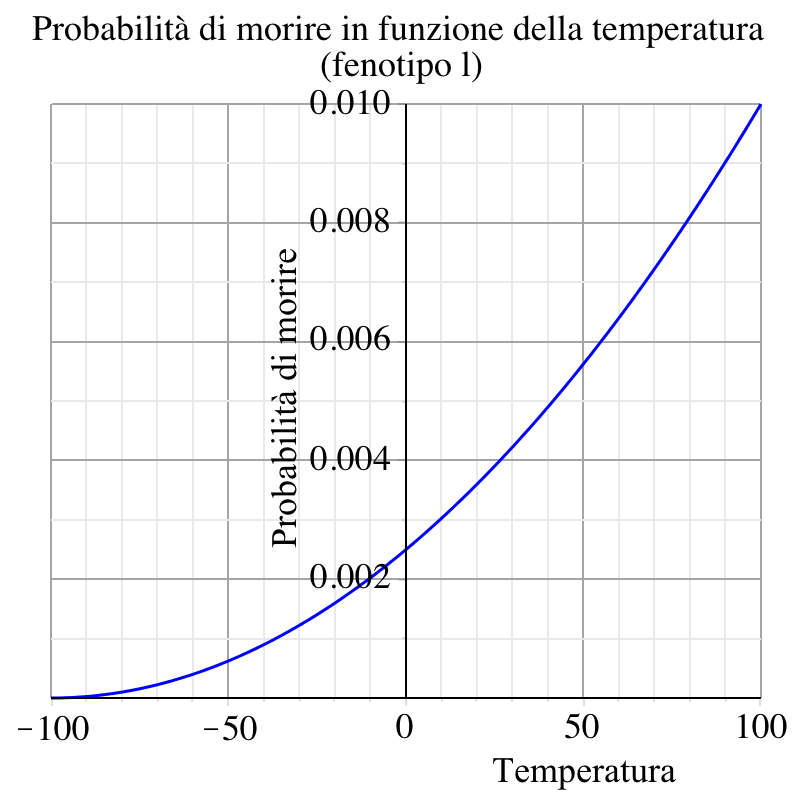
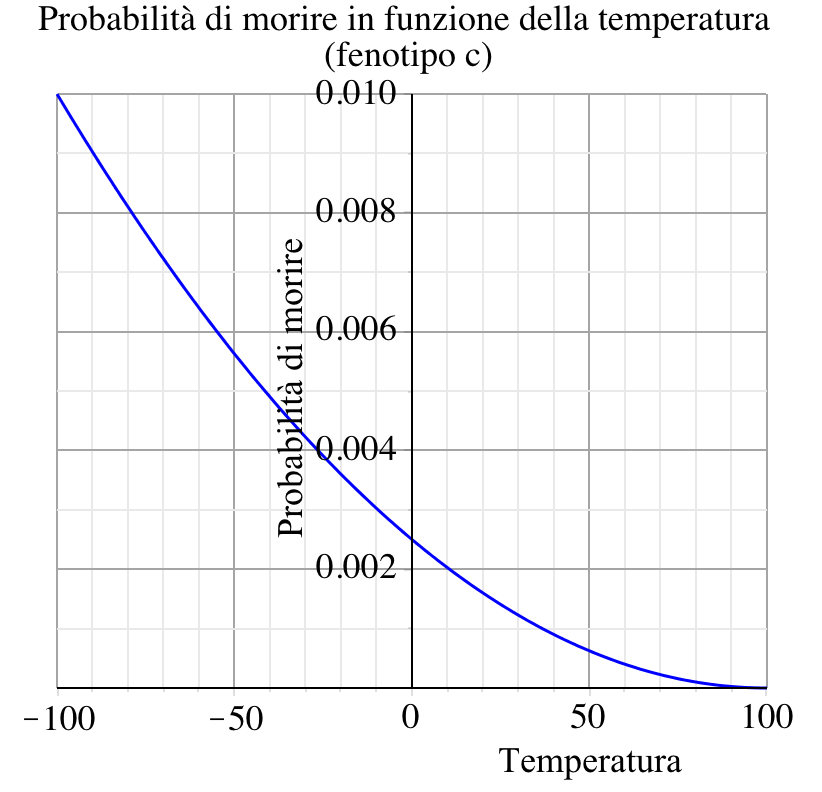
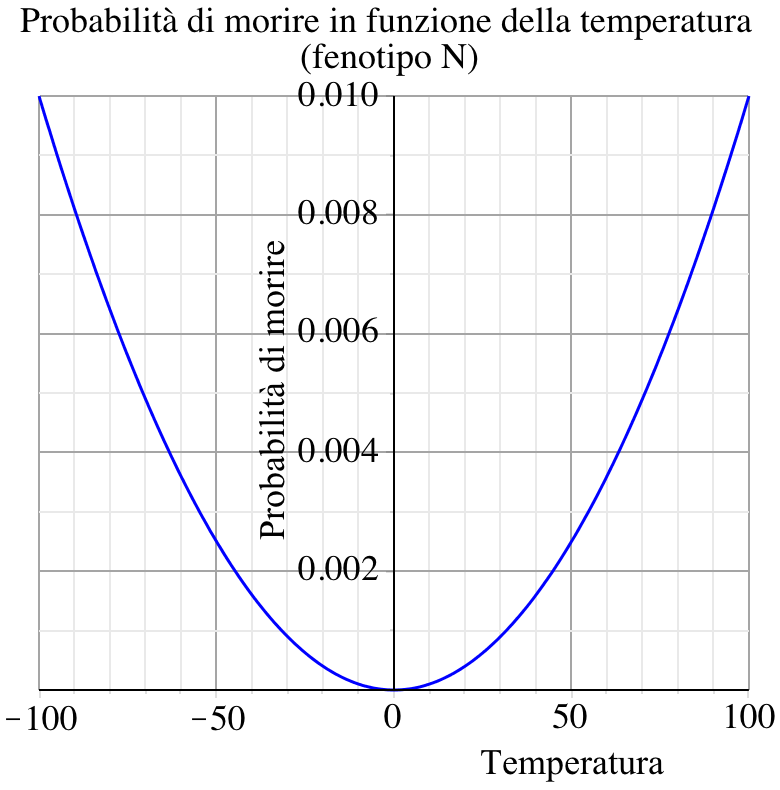
- Temperature: every creature has its own genotype considering its capability of resisting to the temperature (comparable to the presence of fur). In particular there are three different kinds of alleles: a dominant one (N), without particular characteristics; two recessive alleles (l and c), respectively adapt to live in a hot climate and in a cold one. The possible genotypes are homozygous (NN, ll and cc) or heterozygous (Nl, Nc, lc). Genotypes NN, Nl, Nc, and lc correspond to the phenotype N, which is adapt to live in moderate climates and die easily in extreme conditions (hot and cold). Genotypes ll and cc correspond respectively to the phenotypes l and c. The first is adapt to live in cold climates, the second in hot ones. Every tick, a creature has got a certain probability to die because of the temperature, depending on the temperature of the chunk where it is and its phenotype. The probability to die has a maximum value of 0.01 because it is evalueted every tick. If the maximum value was equal to 1, there would be to many deaths.
- Starvation: if a creature can't find enough food for a certain period, its energy gets under a minimum value and the creature dies.
Creatures are characterised by various genes, which are given to the child during reproduction. There are three kinds of genes:
- Numeric genes are a number which represent the phenotype, too. During reproduction, the numeric gene of the child creature is equal to the numeric gene of one of its parents multiplied by a random number (with mean 1), which correspond to random mutation. Numeric genes are:
- agility, la capability of moving of the creature.
- bigness, the size of the creature.
- fertility, express the minimum number of ticks between two reproductions, but it is inversely proportional to the minimum energy to reproduce.
- num_control, a numeric gene used as control gene (it has not got phenotypic effects).
- Mendelian genes are characterised by a couple of alleles and a phenotype, evaluated according to mendelian laws. During reproduction the two alleles are chosen picking one randomly from every parent. Mendelian genes are:
- temp_resist, la capability of the creature to resist to a certain temperature; alleles are c, l (recessive) and N (dominant);
- mind_control, a mendelian genes used as control gene (it has not got phenotypic effects); alleles are a (recessive) and A (dominant).
- Secondary genes are those who are not transmitted during reproduction, but are evaluated from other genes. Secondary genes are:
- speed, defined as 2(agility/bigness)