







📚 Documents: musicdl.readthedocs.io
🎧 Live Demo · MusicSquare (音乐广场)

🛠 Source Code (MusicSquare)
MusicSquare is a browser-based music playground — search, play, and download tracks directly in your browser.
学习收获更多有趣的内容, 欢迎关注微信公众号:Charles的皮卡丘
- 2026-01-01: Released musicdl v2.8.2 — adjusted the FreeProxy API arguments, improved the robustness of fetching high-quality music from NetEase Cloud Music, QQ Music, and Migu Music, and fixed some bugs.
- 2025-12-31: Released musicdl v2.8.1 — support more lossless-music sharing sites, add pagination support for some of the previously supported sites, and fix the Rich display conflict under two-level concurrency with multi-source searching.
- 2025-12-29: Released musicdl v2.8.0 — added support for two additional sites, improved the search speed, stability and metadata completeness when fetching lossless tracks from some sites, and optimized certain default arguments (prioritize search speed).
- 2025-12-24: Released musicdl v2.7.6 — add support for MissEvan FM, and fix bugs on the Gequhai site.
A lightweight music downloader written in pure Python. Like it? ⭐ Star the repository to stay up to date. Thanks!
This project is for educational use only and is not intended for commercial purposes. It interacts with publicly available web endpoints and does not host or distribute copyrighted content. To access paid tracks, please purchase or subscribe to the relevant music service—do not use this project to bypass paywalls or DRM. If you are a rights holder and believe this repository infringes your rights, please contact me and I will promptly address it.
Here are some projects built on top of musicdl,
| Project (EN) | Project (CN) | WeChat Article | Project Location |
|---|---|---|---|
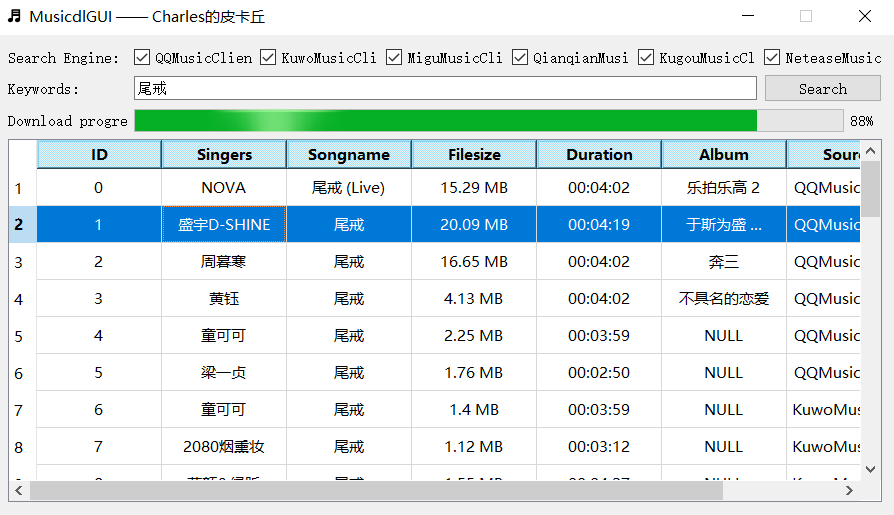
| Music downloader GUI | 音乐下载器GUI界面 | click | musicdlgui |
| Singer lyrics analysis | 歌手歌词分析 | click | singerlyricsanalysis |
| Lyric-based song snippet retrieval | 歌词获取歌曲片段 | click | searchlyrics |
For example, the Music Downloader GUI looks/works like this,
You have three installation methods to choose from,
# from pip
pip install musicdl
# from github repo method-1
pip install git+https://github.com/CharlesPikachu/musicdl.git@master
# from github repo method-2
git clone https://github.com/CharlesPikachu/musicdl.git
cd musicdl
python setup.py install
Some of the music downloaders supported by musicdl require additional CLI tools to function properly, mainly for decrypting encrypted search/download requests and audio files. These CLI tools include,
-
FFmpeg: At the moment, only
TIDALMusicClientandAppleMusicClientdepends on FFmpeg for audio file decoding. If you don’t need to useTIDALMusicClientandAppleMusicClientwhen working with musicdl, you don’t need to install FFmpeg. After installing it, you should run the following command in a terminal (Command Prompt / PowerShell on Windows, Terminal on macOS/Linux) to check whether FFmpeg is on your systemPATH:ffmpeg -version
If FFmpeg is installed correctly and on your
PATH, this command will print the FFmpeg version information (e.g., a few lines starting withffmpeg version ...). If you see an error likecommand not foundor'ffmpeg' is not recognized as an internal or external command, then FFmpeg is either not installed or not added to yourPATH. -
Node.js: Currently, only
YouTubeMusicClientin musicdl depends on Node.js, so if you don’t needYouTubeMusicClient, you don’t have to install Node.js. Similar to FFmpeg, after installing Node.js, you should run the following command to check whether Node.js is on your systemPATH:node -v (npm -v)
If Node.js is installed correctly,
node -vwill print the Node.js version (e.g.,v22.11.0), andnpm -vwill print the npm version. If you see a similarcommand not found/not recognizederror, Node.js is not installed correctly or not available on yourPATH. -
GPAC: GPAC is an open-source multimedia framework for packaging, processing, and streaming formats like MP4, DASH, and HLS. In musicdl, this library is mainly used for handling
AppleMusicClientaudio streams, so if you don’t needAppleMusicClientsupport, you don’t need to install it. After installing GPAC, you need to make sure all of its executables are available in your systemPATH. A quick way to verify this is that you should be able to runpython -c "import shutil; print(shutil.which('MP4Box'))"in Command Prompt and get the full path without an error.
-
Bento4: Bento4 is an open-source C++ toolkit for reading, writing, inspecting, and packaging MP4 files and related multimedia formats. In musicdl, this library is mainly used for handling
AppleMusicClientaudio streams, so if you don’t needAppleMusicClientsupport, you don’t need to install it. After installing Bento4, you need to make sure all of its executables are available in your systemPATH. A quick way to verify this is that you should be able to runpython -c "import shutil; print(shutil.which('mp4decrypt'))"in Command Prompt and get the full path without an error.
-
N_m3u8DL-RE: N_m3u8DL-RE is a powerful open-source command-line tool for downloading, decrypting, and muxing HLS/DASH (m3u8/mpd) streaming media into local video files. In musicdl, this library is mainly used for handling
AppleMusicClientaudio streams, so if you don’t needAppleMusicClientsupport, you don’t need to install it. After installing N_m3u8DL-RE, you need to make sure all of its executables are available in your systemPATH. A quick way to verify this is that you should be able to runpython -c "import shutil; print(shutil.which('N_m3u8DL-RE'))"in Command Prompt and get the full path without an error.
Here, we provide some common musicdl use cases to help you quickly get started with the tool.
If you want the quickest way to run musicdl to verify that your environment meets its basic requirements and that musicdl has been installed successfully, you can write and run the following code,
from musicdl import musicdl

music_client = musicdl.MusicClient(music_sources=['MiguMusicClient', 'NeteaseMusicClient', 'QQMusicClient', 'KugouMusicClient', 'KuwoMusicClient', 'QianqianMusicClient'])
music_client.startcmdui()
The above code runs musicdl using MiguMusicClient, NeteaseMusicClient, QQMusicClient, KugouMusicClient, KuwoMusicClient and QianqianMusicClient as both the search sources and download sources.
Of course, you can also run musicdl by entering the following equivalent command directly in the command line,
musicdl -m NeteaseMusicClient,MiguMusicClient,QQMusicClient,KugouMusicClient,KuwoMusicClient,QianqianMusicClientPlease note that musicdl uses six Mainland China music sources by default for searching. If you need to use overseas music sources, you must manually specify the music platform each time you run the program. For example:
musicdl -m GDStudioMusicClient,JamendoMusicClientIn addition, searching and downloading from many music sources simultaneously may be relatively slow.
Each run may take about 30–60 seconds.
If you are confident that your song can be found on a specific platform or a few platforms, for example, NeteaseMusicClient, QQMusicClient or KuwoMusicClient,
it is recommended to directly specify those platforms:
musicdl -m NeteaseMusicClient,QQMusicClient,KuwoMusicClientThe demonstration is as follows,


You can also use musicdl --help to see the detailed usage of the musicdl command-line tool, as follows:
Usage: musicdl [OPTIONS]

Options:
  --version                       Show the version and exit.
  -k, --keyword TEXT              The keywords for the music search. If left
                                  empty, an interactive terminal will open
                                  automatically.
  -m, --music-sources, --music_sources TEXT
                                  The music search and download sources.
                                  [default: MiguMusicClient,NeteaseMusicClient
                                  ,QQMusicClient,KugouMusicClient,KuwoMusicCli
                                  ent,QianqianMusicClient]
  -i, --init-music-clients-cfg, --init_music_clients_cfg TEXT
                                  Config such as `work_dir` for each music
                                  client as a JSON string.
  -r, --requests-overrides, --requests_overrides TEXT
                                  Requests.get / Requests.post kwargs such as
                                  `headers` and `proxies` for each music
                                  client as a JSON string.
  -c, --clients-threadings, --clients_threadings TEXT
                                  Number of threads used for each music client
                                  as a JSON string.
  -s, --search-rules, --search_rules TEXT
                                  Search rules for each music client as a JSON
                                  string.
  --help                          Show this message and exit.
If you want to change the download path for the music files, you can write the following code:
from musicdl import musicdl

init_music_clients_cfg = dict()
init_music_clients_cfg['MiguMusicClient'] = {'work_dir': 'migu'}
init_music_clients_cfg['NeteaseMusicClient'] = {'work_dir': 'netease'}
init_music_clients_cfg['QQMusicClient'] = {'work_dir': 'qq'}
music_client = musicdl.MusicClient(music_sources=['MiguMusicClient', 'NeteaseMusicClient', 'QQMusicClient'])
music_client.startcmdui()
Alternatively, you can equivalently run the following command directly in the command line:
musicdl -m NeteaseMusicClient,MiguMusicClient,QQMusicClient -i "{'MiguMusicClient': {'work_dir': 'migu'}, {'NeteaseMusicClient': {'work_dir': 'netease'}, {'QQMusicClient': {'work_dir': 'qq'}}"If you are a VIP user on a particular music platform, you can pass the cookies from your logged-in web session on that platform to musicdl to improve the quality of song search and downloads.
Specifically, for example, if you have a membership on QQMusicClient, your code can be written as follows:
from musicdl import musicdl

your_vip_cookies_with_str_or_dict_format = ""
init_music_clients_cfg = dict()
init_music_clients_cfg['QQMusicClient'] = {'default_search_cookies': your_vip_cookies_with_str_or_dict_format, 'default_download_cookies': your_vip_cookies_with_str_or_dict_format}
music_client = musicdl.MusicClient(music_sources=['NeteaseMusicClient', 'QQMusicClient'], init_music_clients_cfg=init_music_clients_cfg)
music_client.startcmdui()
Of course, you can also achieve the same effect by running the following command directly in the command line:
musicdl -m NeteaseMusicClient,QQMusicClient -i "{'QQMusicClient': {'default_search_cookies': your_vip_cookies_with_str_or_dict_format, 'default_download_cookies': your_vip_cookies_with_str_or_dict_format}}"If you want to search for more songs on a specific music platform (e.g., QQMusicClient), you can do the following:
from musicdl import musicdl

init_music_clients_cfg = dict()
init_music_clients_cfg['QQMusicClient'] = {'search_size_per_source': 20}
music_client = musicdl.MusicClient(music_sources=['NeteaseMusicClient', 'QQMusicClient'], init_music_clients_cfg=init_music_clients_cfg)
music_client.startcmdui()
Or enter the following in the command line:
musicdl -m NeteaseMusicClient,QQMusicClient -i "{'QQMusicClient': {'search_size_per_source': 20}}"In this way, you can see up to 20 search results from QQMusicClient.
If you want to use the pyfreeproxy library to automatically leverage free online proxies for music search and download, you can do it as follows:
from musicdl import musicdl

init_music_clients_cfg = dict()
init_music_clients_cfg['NeteaseMusicClient'] = {
    'search_size_per_source': 1000, 'auto_set_proxies': True,
    'freeproxy_settings': dict(
        proxy_sources=["ProxyScrapeProxiedSession", "ProxylistProxiedSession"],
        init_proxied_session_cfg={"max_pages": 2, "filter_rule": {"country_code": ["CN"], "anonymity": ["elite"], "protocol": ["http", "https"]}},
        disable_print=True,
        max_tries=20
    )
}
music_client = musicdl.MusicClient(music_sources=['NeteaseMusicClient'], init_music_clients_cfg=init_music_clients_cfg)
music_client.startcmdui()
The command-line usage is similar:
musicdl -m NeteaseMusicClient -i "{'NeteaseMusicClient': {'search_size_per_source': 1000, 'auto_set_proxies': True, 'freeproxy_settings': {'proxy_sources':['ProxyScrapeProxiedSession','ProxylistProxiedSession'],'init_proxied_session_cfg':{'max_pages':2,'filter_rule':{'country_code':['CN'],'anonymity':['elite'],'protocol':['http','https']}},'disable_print':True,'max_tries':20}}}"You can also call the .search and .download interfaces of musicdl separately to inspect its intermediate results or perform secondary development,
from musicdl import musicdl

# instance
music_client = musicdl.MusicClient(music_sources=['NeteaseMusicClient'])
# search
search_results = music_client.search(keyword='尾戒')
print(search_results)
song_infos = []
for song_infos_per_source in list(search_results.values()):
    song_infos.extend(song_infos_per_source)
# download
music_client.download(song_infos=song_infos)
You can also choose not to use the unified MusicClient interface and instead directly import the definition class for a specific music platform for secondary development.
For example, to import the definition class for NeteaseMusicClient:
from musicdl.modules.sources import NeteaseMusicClient

netease_music_client = NeteaseMusicClient()
# search
search_results = netease_music_client.search(keyword='那些年')
print(search_results)
# download
netease_music_client.download(song_infos=search_results)
All supported classes can be obtained by printing MusicClientBuilder.REGISTERED_MODULES, e.g,
from musicdl.modules import MusicClientBuilder

print(MusicClientBuilder.REGISTERED_MODULES)On some music platforms, it’s not possible to obtain the lyric files corresponding to the audio, e.g, XimalayaMusicClient and MituMusicClient.
To handle this, we provide a faster-whisper interface that can automatically generate lyrics for tracks whose lyrics are unavailable for download.
For audio files that have already been downloaded, you can use the following invocation to automatically generate lyrics for the local file,
from musicdl.modules import WhisperLRC

your_local_music_file_path = 'xxx.flac'
WhisperLRC(model_size_or_path='base').fromfilepath(your_local_music_file_path)
The available model_size_or_path, ordered from smallest to largest, are:
tiny, tiny.en, base, base.en, small, small.en, distil-small.en, medium, medium.en, distil-medium.en, large-v1, large-v2, large-v3, large, distil-large-v2, distil-large-v3, large-v3-turbo, turboIn general, the larger the model, the better the generated lyrics (transcription/translation) will be, but this also means it will take longer to run.
If you want to automatically generate lyric files during the download process,
you can set the environment variable ENABLE_WHISPERLRC=True (for example, by running export ENABLE_WHISPERLRC=True).
However, this is generally not recommended, as it may cause a single run of the program to take a very long time,
unless you set search_size_per_source to 1 and model_size_or_path to tiny.
Of course, you can also directly call .fromurl to generate a lyrics file for a song given by a direct URL:
from musicdl.modules import WhisperLRC

music_file_link = ''
WhisperLRC(model_size_or_path='base').fromurl(music_link)Some websites share high-quality or lossless music files via Quark Netdisk links, for example, MituMusicClient, GequbaoMusicClient, YinyuedaoMusicClient, and BuguyyMusicClient.
If you want to download high-quality or lossless audio files from these music platforms, you need to provide the cookies from your logged-in Quark Netdisk web session when calling musicdl. For example, you can do the following:
from musicdl import musicdl

init_music_clients_cfg = dict()
init_music_clients_cfg['YinyuedaoMusicClient'] = {'quark_parser_config': {'cookies': your_cookies_with_str_or_dict_format}}
init_music_clients_cfg['GequbaoMusicClient'] = {'quark_parser_config': {'cookies': your_cookies_with_str_or_dict_format}}
init_music_clients_cfg['MituMusicClient'] = {'quark_parser_config': {'cookies': your_cookies_with_str_or_dict_format}}
init_music_clients_cfg['BuguyyMusicClient'] = {'quark_parser_config': {'cookies': your_cookies_with_str_or_dict_format}}

music_client = musicdl.MusicClient(music_sources=['MituMusicClient', 'YinyuedaoMusicClient', 'GequbaoMusicClient', 'BuguyyMusicClient'], init_music_clients_cfg=init_music_clients_cfg)
music_client.startcmdui()
Please note that musicdl does not provide any speed-limit bypass for Quark Netdisk. If the cookies you supply belong to a non-VIP Quark account, the download speed may be limited to only a few hundred KB/s.
Also note that Quark Drive will first save the music file to your own Quark account (usually in the "From: Shares (来自: 分享)" folder) and then start the download. Therefore, if your Quark storage is insufficient, the download may fail.
If you want to download lossless-quality music from TIDAL, you need to make sure that PyAV is available or that FFmpeg is in your environment variables, and then use musicdl as follows:
from musicdl import musicdl

music_client = musicdl.MusicClient(music_sources=['TIDALMusicClient'])
music_client.startcmdui()
Running the above code will automatically open your default browser and prompt you to log in to TIDAL. Once you have successfully logged in, musicdl will automatically capture the tokens from your session to support subsequent music search and download.
If you are running on a remote server where the browser cannot be opened automatically, you can instead copy the URL printed in the terminal and open it in your local browser to complete the login process.
Note that if the account you log in with is not a paid TIDAL subscription, you will still be unable to download the full lossless audio files.
If you want to use musicdl to search for and download music from YouTubeMusicClient, you must have Node.js installed, e.g., on Linux, you can install Node.js using the following script:
#!/usr/bin/env bash
set -e

# Install nvm (Node Version Manager)
curl -fsSL https://raw.githubusercontent.com/nvm-sh/nvm/v0.40.0/install.sh | bash

# Load nvm for this script
export NVM_DIR="$HOME/.nvm"
[ -s "$NVM_DIR/nvm.sh" ] && . "$NVM_DIR/nvm.sh"

# Install and use latest LTS Node.js
nvm install --lts
nvm use --lts

# Print versions
node -v
npm -v
On macOS, you can install Node.js using the following script:
#!/usr/bin/env bash
set -e

# Install nvm (Node Version Manager)
curl -fsSL https://raw.githubusercontent.com/nvm-sh/nvm/v0.40.0/install.sh | bash

# Load nvm for this script
export NVM_DIR="$HOME/.nvm"
[ -s "$NVM_DIR/nvm.sh" ] && . "$NVM_DIR/nvm.sh"

# Install and use latest LTS Node.js
nvm install --lts
nvm use --lts

# Print versions
node -v
npm -v
On Windows (PowerShell), you can install Node.js using the following script:
# Install Node.js LTS via winget
winget install --id OpenJS.NodeJS.LTS -e --source winget

# Print hint for version check
Write-Output ""
Write-Output "Please reopen PowerShell and run:"
Write-Output "  node -v"
Write-Output "  npm -v"
A simple example of searching for and downloading music from YouTubeMusicClient is as follows,
from musicdl import musicdl

music_client = musicdl.MusicClient(music_sources=['YouTubeMusicClient'])
music_client.startcmdui()AppleMusicClient works similarly to TIDALMusicClient:
if you are not an Apple Music subscriber or you have not manually set in musicdl the cookies (i.e., the media-user-token) from your logged-in Apple Music session in the browser,
you will only be able to download a partial segment of each track (usually 30–90 seconds).
If you need to download the full audio and lyrics for each song, you can configure musicdl as follows:
from musicdl import musicdl

cookies = {'media-user-token': xxx}
init_music_clients_cfg = {'AppleMusicClient': {'default_search_cookies': cookies, 'default_download_cookies': cookies, 'search_size_per_source': 10}}
music_client = musicdl.MusicClient(music_sources=['AppleMusicClient'], init_music_clients_cfg=init_music_clients_cfg)
music_client.startcmdui()
It is important to note that to download Apple Music audio files (including decryption) using musicdl, you must properly install GPAC, Bento4 and N_m3u8DL-RE.
We’ve added GDStudioMusicClient to musicdl as a practical solution for users who are on a tight budget or who find it difficult to configure extra command-line tools/arguments for musicdl.
With only the basic installation of musicdl, you can search for and download high-quality music files from the following music platforms:
| Source (EN) | Source (CN) | Official Websites | allowed_music_sources |
|---|---|---|---|
| Spotify | Spotify | https://www.spotify.com | spotify |
| Tencent (QQ Music) | QQ音乐 | https://y.qq.com | tencent |
| NetEase Cloud Music | 网易云音乐 | https://music.163.com | netease |
| Kuwo | 酷我音乐 | https://www.kuwo.cn | kuwo |
| TIDAL | TIDAL | https://tidal.com | tidal |
| Qobuz | Qobuz | https://www.qobuz.com | qobuz |
| JOOX | JOOX | https://www.joox.com | joox |
| Bilibili | 哔哩哔哩 | https://www.bilibili.com | bilibili |
| Apple Music | 苹果音乐 | https://www.apple.com/apple-music/ | apple |
| YouTube Music | 油管音乐 | https://music.youtube.com | ytmusic |
Specifically, you just need to write and run a few lines of code like this:
from musicdl import musicdl

music_client = musicdl.MusicClient(music_sources=['GDStudioMusicClient'])
music_client.startcmdui()
Or, equivalently, run the following command in the command line:
musicdl -m GDStudioMusicClientBy default, the above code will search for and download music from nine music platforms, excluding YouTube Music (as using GDStudioMusicClient for search and download on this platform seems to be unstable).
The screenshot of the running result is as follows:

However, please note that this way of running is not very stable (e.g., some sources may fail to find any valid songs) and is likely to exceed the limit on the number of requests per minute allowed for a single IP by GDStudioMusicClient.
If you still wish to perform a full-platform search, we recommend modifying the default arguments as follows:
from musicdl import musicdl

init_music_clients_cfg = {'GDStudioMusicClient': {'search_size_per_source': 1}}
music_client = musicdl.MusicClient(music_sources=['GDStudioMusicClient'], init_music_clients_cfg=init_music_clients_cfg)
music_client.startcmdui()
The equivalent command in the command line is:
musicdl -m GDStudioMusicClient -i "{'GDStudioMusicClient': {'search_size_per_source': 1}}"Or, an even better option is to manually specify a few platforms where you believe your desired music files are likely to be found, for example:
from musicdl import musicdl

# allowed_music_sources can be set to any subset (i.e., any combination) of ['spotify', 'tencent', 'netease', 'kuwo', 'tidal', 'qobuz', 'joox', 'bilibili', 'apple', 'ytmusic']
init_music_clients_cfg = {'GDStudioMusicClient': {'search_size_per_source': 5, 'allowed_music_sources': ['spotify', 'qobuz', 'tidal', 'apple']}}
music_client = musicdl.MusicClient(music_sources=['GDStudioMusicClient'], init_music_clients_cfg=init_music_clients_cfg, clients_threadings=clients_threadings)
music_client.startcmdui()
The way to run it from the command line is similar:
musicdl -m GDStudioMusicClient -i "{'GDStudioMusicClient': {'search_size_per_source': 5, 'allowed_music_sources': ['spotify', 'qobuz', 'tidal', 'apple']}}"TuneHubMusicClient is actually quite similar to GDStudioMusicClient, as it allows music search and download from multiple music platforms.
However, it primarily supports music platforms in Mainland China and offers fewer music sources compared to GDStudioMusicClient.
Specifically, the list of platforms it currently supports is as follows:
| Source (EN) | Source (CN) | Official Websites | allowed_music_sources |
|---|---|---|---|
| Tencent (QQ Music) | QQ音乐 | https://y.qq.com | qq |
| NetEase Cloud Music | 网易云音乐 | https://music.163.com | netease |
| Kuwo | 酷我音乐 | https://www.kuwo.cn | kuwo |
Specifically, you can call it using the following code:
from musicdl import musicdl

music_client = musicdl.MusicClient(music_sources=['TuneHubMusicClient'])
music_client.startcmdui()
Alternatively, you can directly run the following command in the terminal:
musicdl -m TuneHubMusicClientThe screenshot of the running result is as follows:

For more details, please refer to the official documentation.
| Project | ⭐ Stars | 📦 Version | ⏱ Last Update | 🛠 Repository |
|---|---|---|---|---|
| 🎵 Musicdl 轻量级无损音乐下载器 |
 |
|
 |
🛠 Repository |
| 🎬 Videodl 轻量级高清无水印视频下载器 |
 |
 |
 |
🛠 Repository |
| 🖼️ Imagedl 轻量级海量图片搜索下载器 |
 |
 |
 |
🛠 Repository |
| 🌐 FreeProxy 全球海量高质量免费代理采集器 |
 |
 |
 |
🛠 Repository |
| 🌐 MusicSquare 简易音乐搜索下载和播放网页 |
 |
|
 |
🛠 Repository |
| 🌐 FreeGPTHub 真正免费的GPT统一接口 |
 |
 |
 |
🛠 Repository |
If you use this project in your research, please cite the repository.
@misc{musicdl2020,
    author = {Zhenchao Jin},
    title = {Musicdl: A lightweight music downloader written in pure python},
    year = {2020},
    publisher = {GitHub},
    journal = {GitHub repository},
    howpublished = {\url{https://github.com/CharlesPikachu/musicdl}},
}
| WeChat Appreciation QR Code (微信赞赏码) | Alipay Appreciation QR Code (支付宝赞赏码) |
|---|---|
 |
 |
Charles的皮卡丘 (Charles_pikachu)